
Loading…
Your OPT gives you about 90 days to land a sponsoring job. Do not spend them on companies that never sponsor.
Methodology
Every score on SponsorRight comes from public DOL and USCIS filings, not a guess and not a paid placement. This page explains what goes into it, where the numbers come from, and where the record runs out.
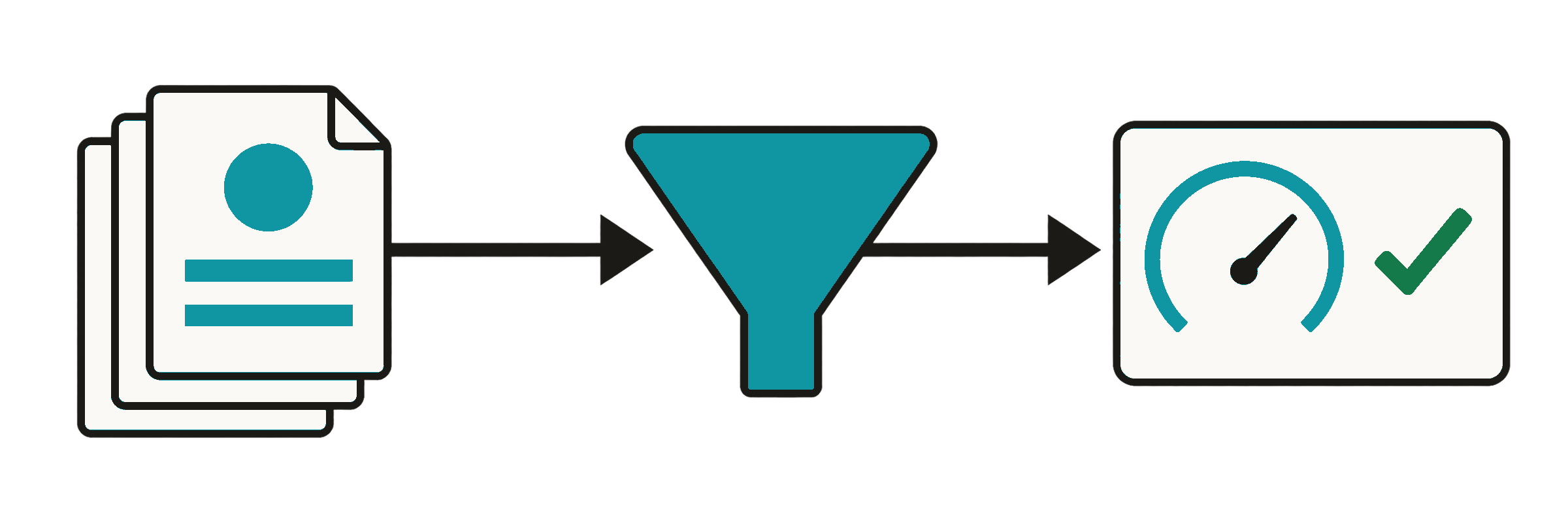
Every job gets a score from 0 to 100, built entirely from its employer's public filing record. Five factors are combined and clamped to that range. Every factor that touched a given job's score is shown on that job's own evidence panel, not just here.
How many filings this employer has in the most recent fiscal year. Scaled so the first few filings matter most and each additional one adds less. A single filing is worth something; a hundred isn't twice as strong as fifty.
Whether filings grew or shrank compared to the prior fiscal year. A sharp drop (more than half) counts against the score; growth counts slightly for it.
Whether this employer's recent filings were for the same kind of role as this job. A generic title match against the employer's filing history, not an authoritative SOC code lookup.
Whether this employer has filed for a worker in the same state as this job's worksite.
Approval rate on this employer's recent cases, centered on 70%. Only applied when approval/denial data exists (USCIS Employer Data Hub coverage, not every employer).
Some employers file plenty of H-1Bs but say no to sponsorship on most of their other open postings. When at least a quarter of an employer's recent postings say this, the score is reduced. Below that, it has no effect.
A high score means this employer has a real, recent, and specific pattern of sponsorship filings. It's an evidence index from public records, not a probability that this employer will sponsor a given candidate for this role.
Each job can show more than one eligibility badge. Style, not just color, tells you how strong the basis is.
Two federal sources, both public record. No self-reported "we sponsor visas" claims from employers.
Labor Condition Applications (H-1B, H-1B1, E-3) and PERM disclosure data (the labor certification step behind most employer-sponsored green cards). Both are case-level filings, refreshed weekly.
H-1B Employer Data Hub: approval and denial counts per employer, per fiscal year. Published annually and one year behind. It backs the approval-rate factor when an employer has coverage there.
Scores currently weigh filings from FY2027 and FY2026. Live job listings are re-checked against their source board every 6 hours; a job's own "Last checked" date is on its detail page.
The three sponsorship-evidence filters on the jobs page run on the same public filing data as the score. Each one only matches employers whose record actually contains that data: missing data is treated as unknown, never as a zero, and unknown employers simply drop out while a filter is set.
USCIS approvals divided by all USCIS decisions (approvals plus denials) for the employer, over its two most recent years in the H-1B Employer Data Hub. Rounded down, so "90%+" is strictly true. Note the national H-1B approval rate is high, so most established sponsors clear 90%.
Filings in the latest complete fiscal year (FY2026) versus the year before, all visa types combined. At least 15% more counts as growing, at least 15% fewer counts as declining, anything between is steady. Employers missing either year are unknown, not declining.
The most recent fiscal year with any filing on record for the employer, from DOL LCA and PERM data. "This fiscal year" means the current, still-in-progress federal fiscal year, which is why it can look one year ahead of the trend comparison.
Citizenship and current status change which visas are even possible: E-3 is Australia only, TN is Canada or Mexico, H-1B1 is Chile or Singapore. Without that, we'd show every candidate every visa and let them find out it doesn't apply after applying. Every field is optional, none of it is shared or sold, and it's only used to filter and score jobs for your own account. You can review or clear it any time from your profile.